I've been thinking about kamarbands a lot lately. Not in a “trending on TikTok” way — in a personal way. My mum has one that her mother gave her before her wedding. Gold, delicate, with these tiny bell-shaped drops that make the faintest sound when she walks. She doesn't wear it anymore. It sits in a velvet pouch inside a drawer. But she keeps it.
I asked her once why she doesn't wear it and she looked at me like I'd asked a stupid question. “Where would I wear it?” she said. And she's right, kind of. There isn't really a space for it in everyday Western life. Which is a shame, because it's one of the most beautiful pieces of jewellery I've ever seen.
That's where this project started. In that drawer.
A Bit of Context
The kamarband has been part of South Asian adornment for centuries. You see it in Mughal miniature paintings from the 1500s. It was a symbol of femininity, of married life, of celebration. In parts of India it's still an essential part of bridal jewellery — not just decorative, but functional. It holds the saree in place.
But outside of weddings and festivals, it's largely disappeared from daily wear. Which means an entire generation of South Asian women have grown up knowing what a kamarband is — maybe they've worn one once, at a wedding — without it being part of their actual wardrobe. It exists in a cultural memory that's fading, slowly, the way these things do when nobody makes an effort to keep them visible.
And then of course the Western fashion industry “discovered” the belly chain in the early 2000s. Paris Hilton wore one. It became a festival accessory. And all that history just... disappeared from the conversation.
What We're Planning
Over the next few months, we're building something we've been talking about internally for a while. We want to create a visual showcase of kamarbands on South Asian women — not a product campaign, not a brand collaboration, just a celebration of this piece of jewellery and the women who wear it.
The idea is this: we're reaching out to creators and influencers who'd be interested in providing a midriff photo of themselves. It doesn't need to be studio-quality — a clean, well-lit shot is perfect. What we're going to do is use AI to superimpose different kamarband styles onto the image. Traditional Mughal designs, contemporary minimalist chains, ornate bridal pieces, everyday subtle bands. Different styles on different bodies, showing the range and the beauty of what this jewellery can look like when it's actually worn.
The end goal is print. We want to produce something physical — a zine, a poster series, maybe both. Something you can hold. Something that exists outside of a phone screen and an algorithm. Because kamarbands are tactile, intimate things. They deserve to be showcased in a medium that has some of that same weight.
Early Examples — The Kamarband Project
Below are some of the styles we've been exploring — from ornate bridal pieces to minimal everyday chains. Click any image to see it in full.
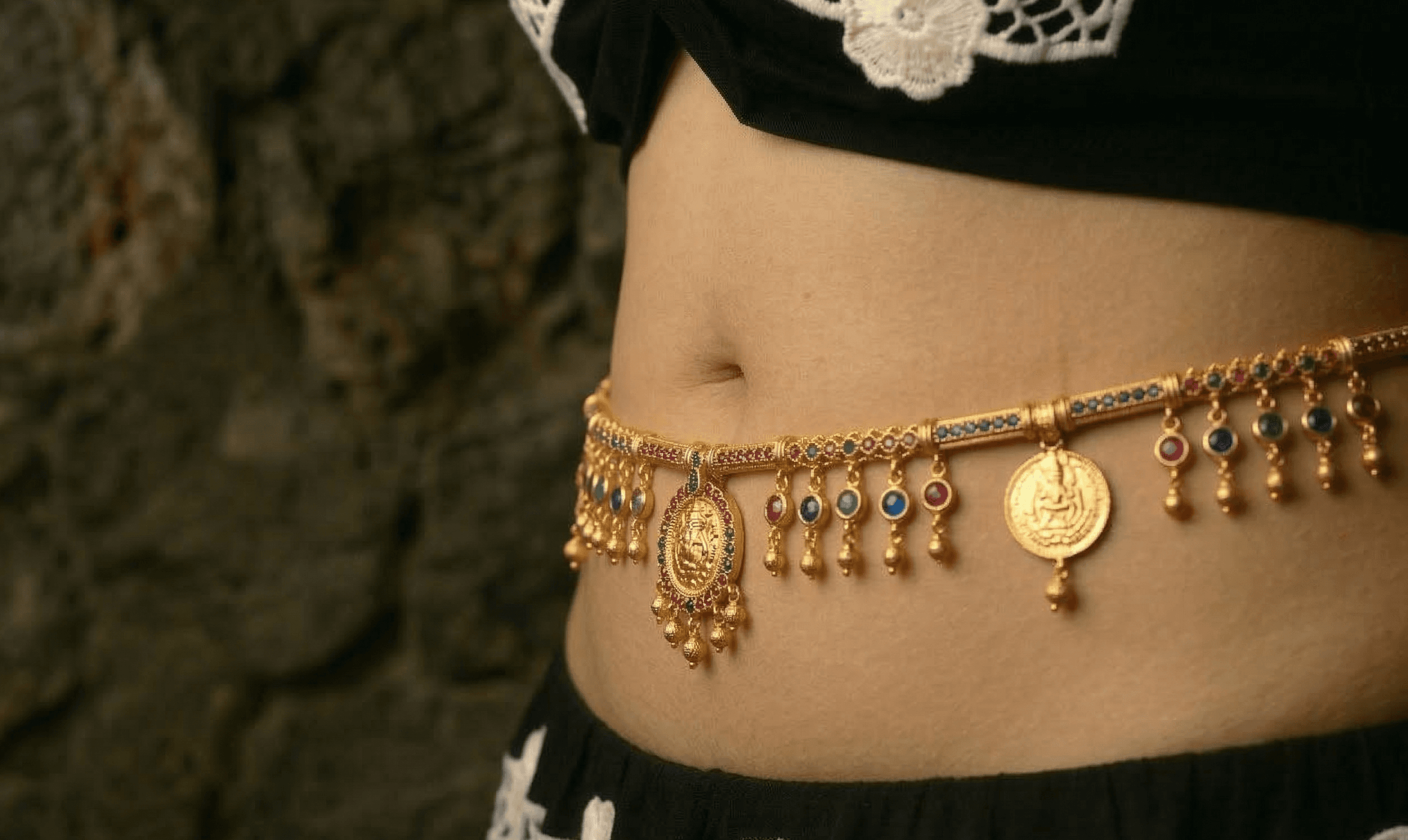
Temple Coin Kamarband
A traditional Lakshmi coin kamarband with multicoloured gemstone drops and bell-shaped ghungroo pendants. This style originates from South Indian temple jewellery traditions, where each coin bears the image of a deity. Paired here with a black cotton blouse and lace detailing.
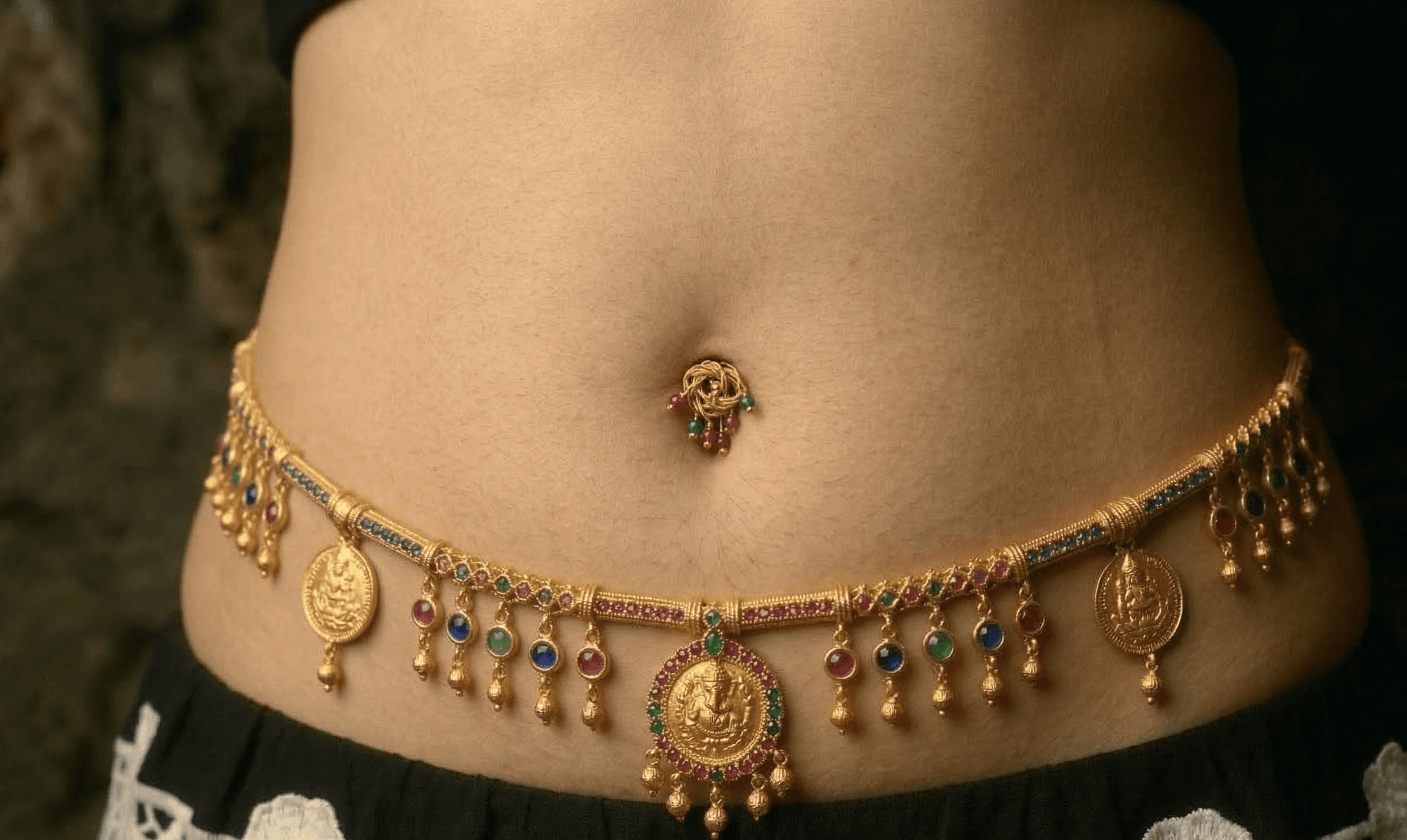
Ornate Bridal Kamarband with Navel Piece
A heavy ceremonial kamarband featuring Lakshmi medallions, ruby and emerald drops, and a matching navel ornament. This style is typically reserved for bridal wear in South Indian weddings, where the kamarband is considered an essential part of the solah shringar — the sixteen bridal adornments.
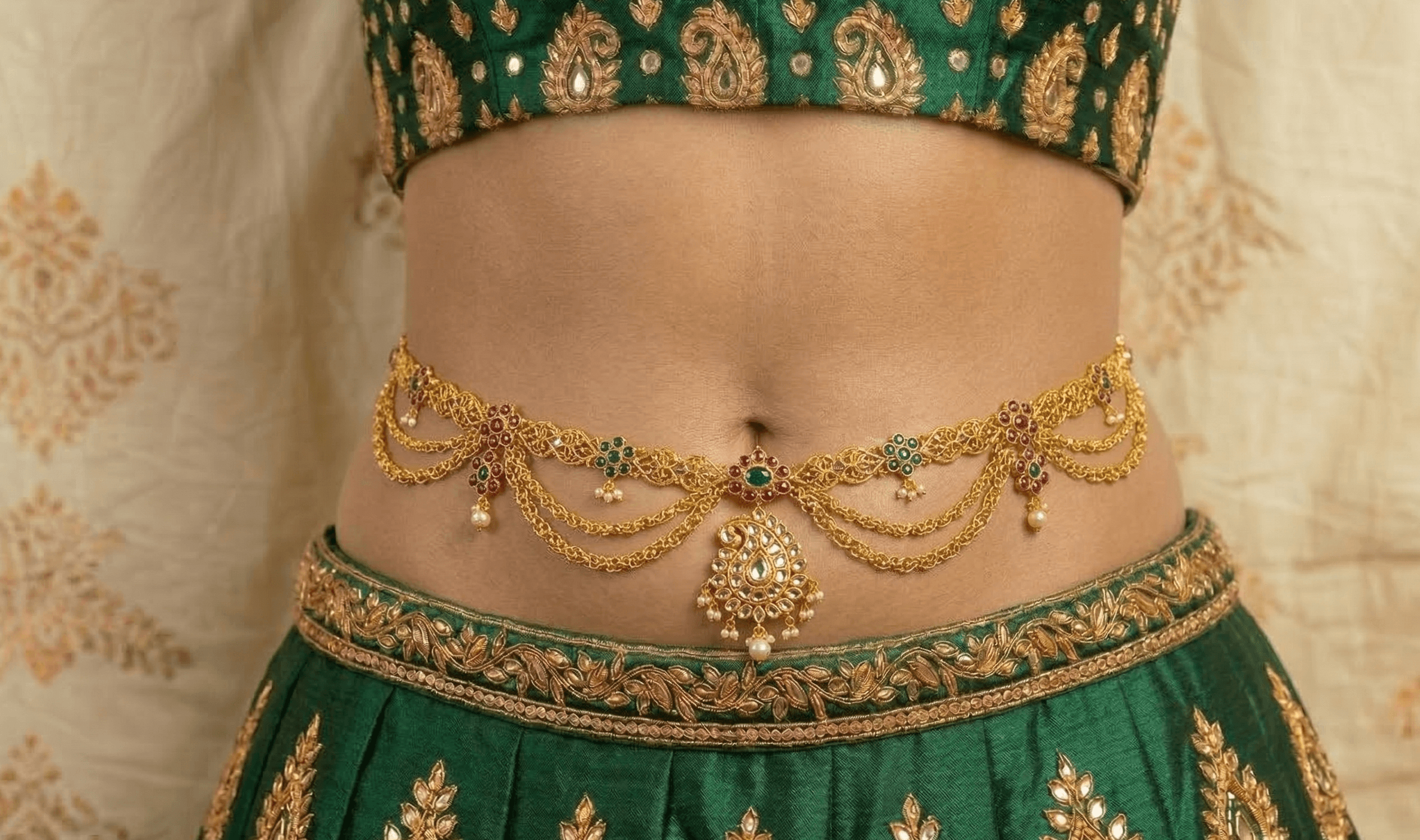
Draped Chain Kamarband
An elegant multi-chain kamarband with kundan-set floral motifs and pearl drops, layered in cascading loops. Styled with an emerald green lehenga with gold zardozi embroidery. This draped style is popular in Rajasthani and Gujarati bridal traditions.
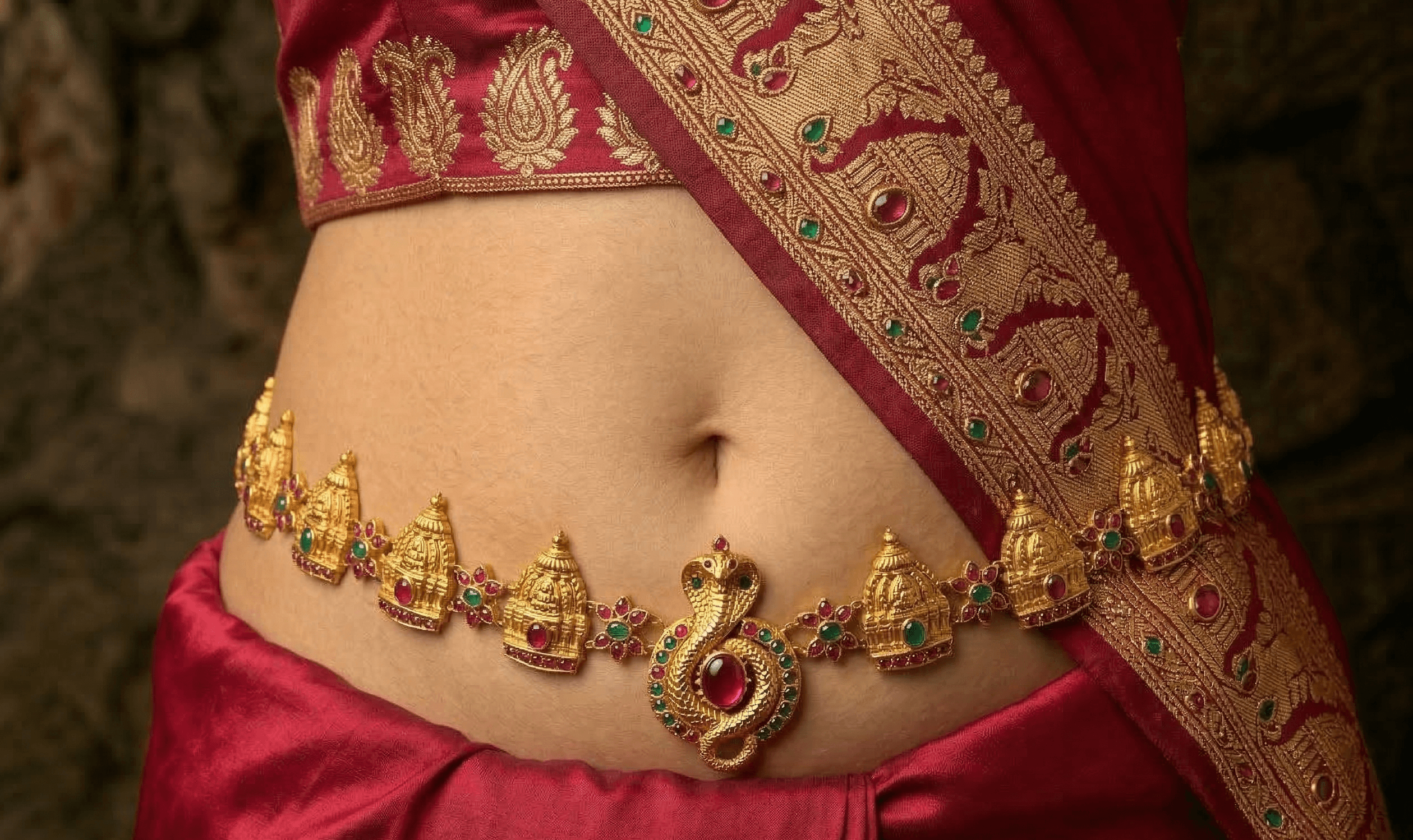
Temple Tower Kamarband
A statement piece featuring gopuram-inspired tower motifs set with rubies and emeralds, centred around a large peacock pendant with a cabochon ruby. Worn here with a crimson silk saree — this style draws directly from Chola-era temple architecture translated into goldsmith work.

Minimalist Bridal Chain
A delicate double-strand gold chain with scattered gemstone drops in ruby, emerald, and pearl. A quieter, more contemporary take on the kamarband, designed to complement rather than compete with the lehenga’s heavy embroidery. Increasingly popular with modern brides who want tradition without the weight.
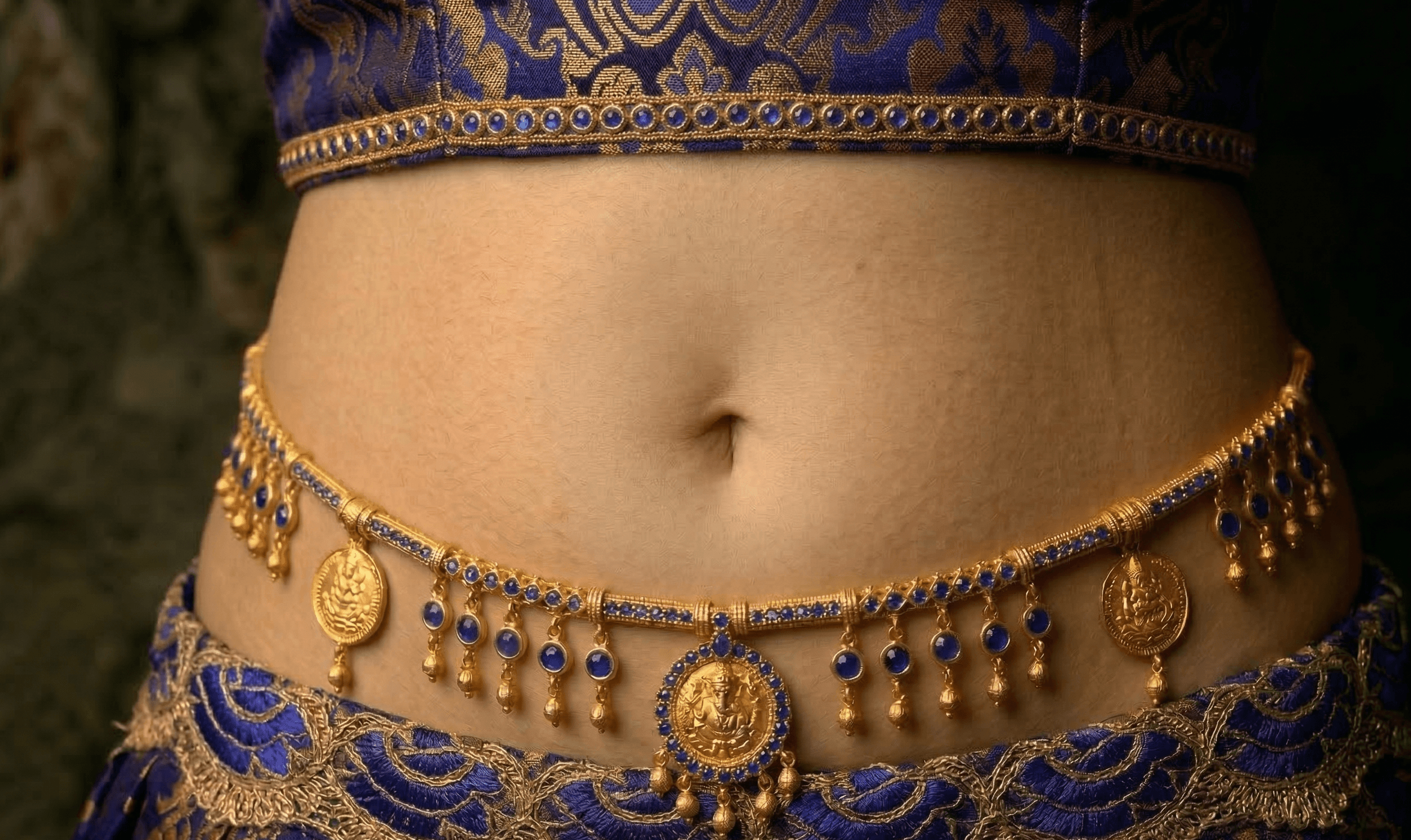
Blue Silk Kamarband
A traditional coin-drop kamarband with sapphire-blue stone accents, paired with a royal blue Banarasi silk fabric. The blue-and-gold combination references Mughal court jewellery, where lapis lazuli and sapphires were favoured by empresses and courtesans alike.
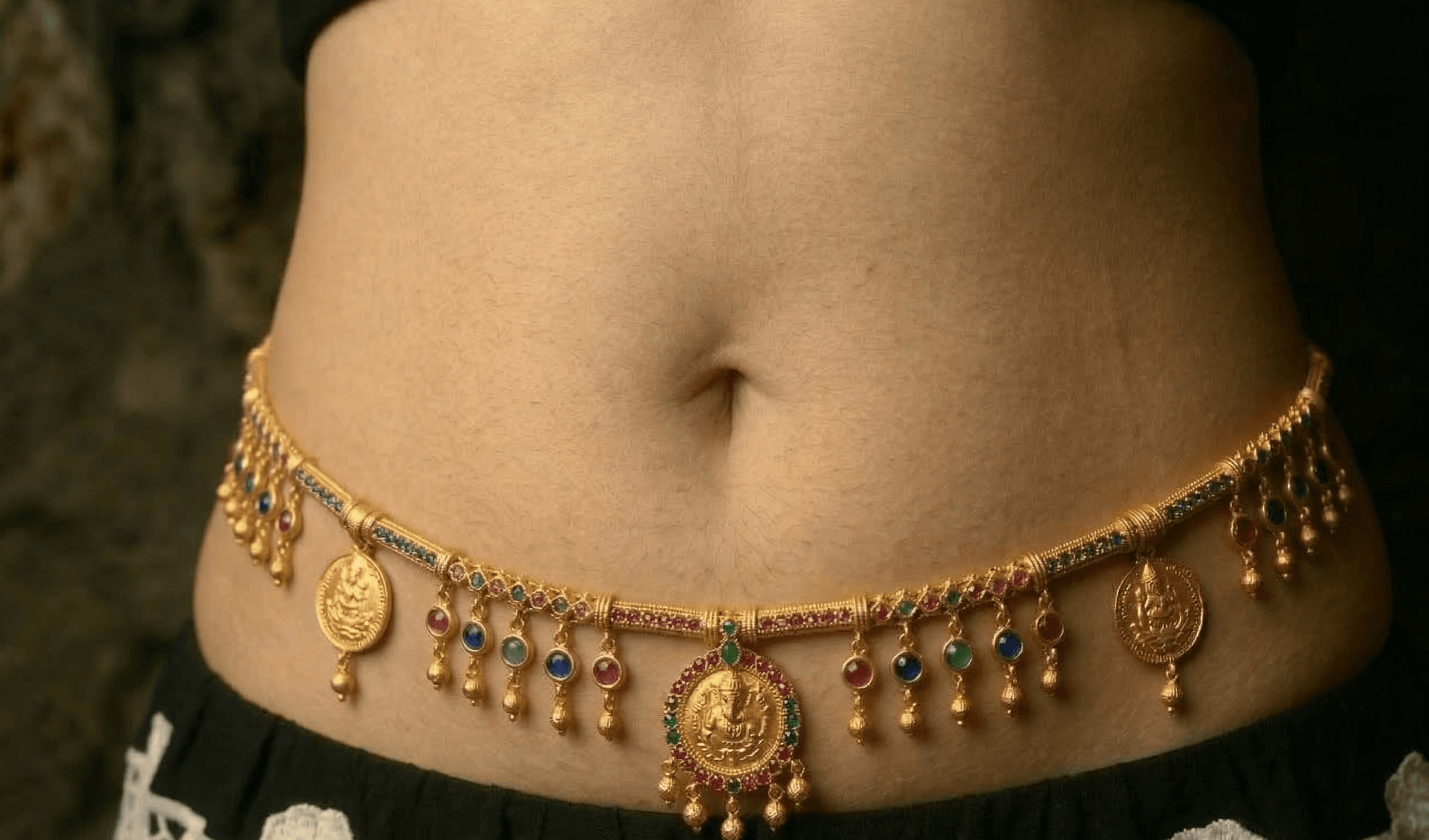
Classic Coin Drop
A single-strand kamarband with evenly spaced Lakshmi coins and multicoloured gemstone beading. This is arguably the most recognisable kamarband style — the one you’ll find in most South Indian jewellery stores. Simple, bold, and timeless.
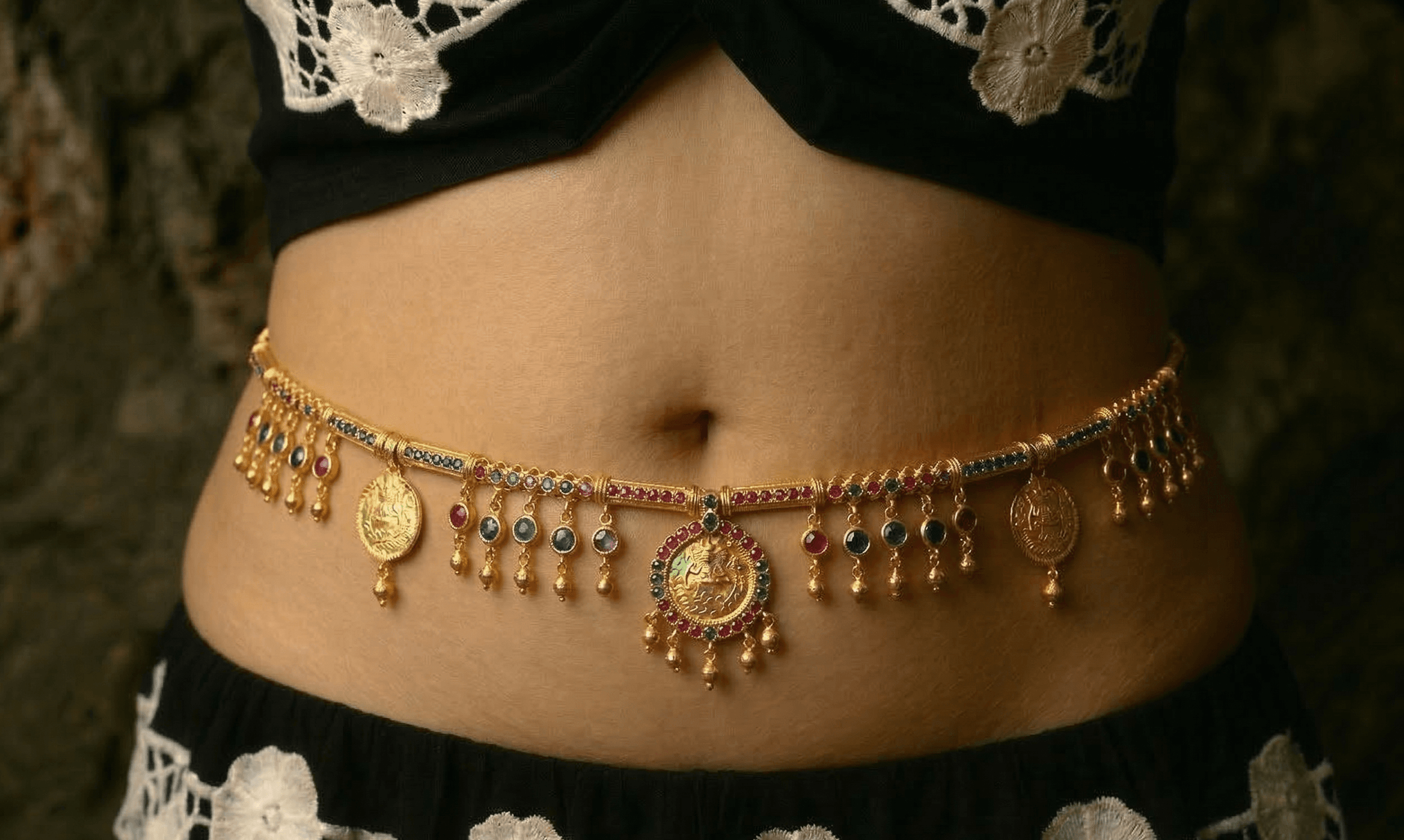
Festival Kamarband
A medium-weight kamarband with a central medallion flanked by smaller coins and ghungroo bell drops. The lace-trimmed blouse suggests a more casual, festival-ready styling — the kind of kamarband you might wear to Navratri or a sangeet, not just a wedding.

Everyday Coin Chain
A minimal gold chain with three spaced coin pendants — the most understated piece in the collection. This is the kamarband reimagined for daily wear. Light enough to forget you’re wearing it, beautiful enough that you wouldn’t want to.
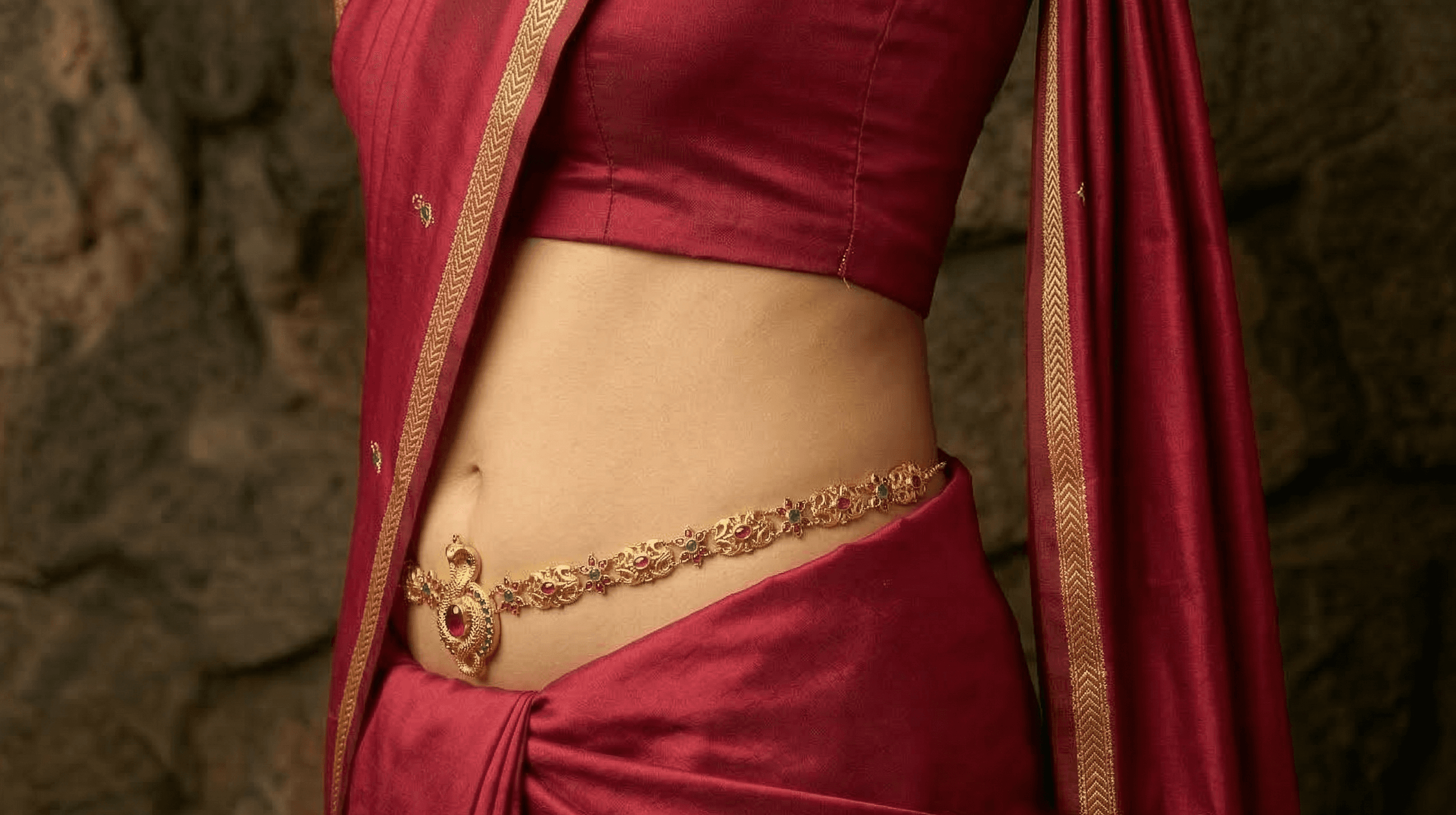
Saree Kamarband
A floral-motif kamarband with a central peacock pendant, worn low on the hip with a draped crimson silk saree. This styling shows the kamarband in its most traditional context — as a functional piece that holds the saree pleats in place while adding an ornamental flourish.
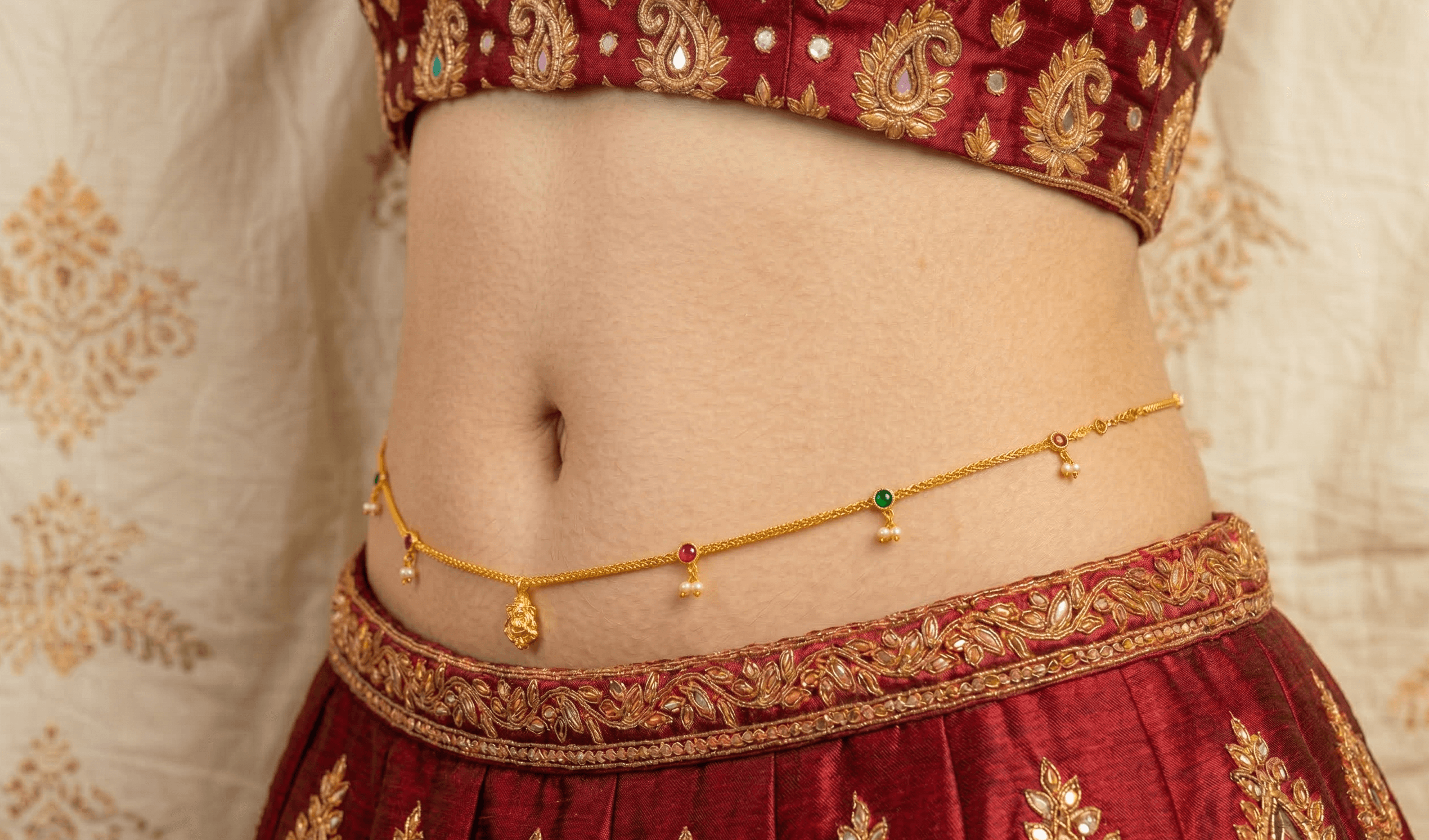
Bridal Lehenga Pairing
A delicate double chain with gemstone drops styled against a heavily embroidered red and gold bridal lehenga. The kamarband sits at the natural waist, bridging the gap between the choli and skirt — the traditional placement that’s been consistent across centuries of South Asian bridal wear.
Why AI, and Why It Matters to Get It Right
I know what some people will think. AI and cultural heritage in the same sentence makes a lot of people (rightly) nervous. So let me be clear about what we're doing and why.
The AI isn't replacing the jewellery or the women. The women are real. The photos are theirs. What the AI does is allow us to show dozens of kamarband styles without needing to source and physically fit each one. It means a creator in Birmingham can see what a traditional Rajasthani kamarband might look like on her. A woman in Karachi can see a modern minimalist chain superimposed onto her photo alongside an ornate vintage piece.
It's a tool for visualisation, not fabrication. The bodies are real. The cultural context is real. The AI just lets us show more possibilities than we could practically photograph.
We're being careful with this. Every creator who submits a photo will see and approve the final image before it goes anywhere. If they don't like how a particular style looks, it gets pulled. No questions. Their image, their call.
Who We're Looking For
We're looking for South Asian women — creators, influencers, or honestly just anyone who's interested — who'd like to be part of this. You don't need a massive following. You don't need professional equipment. You just need to be comfortable providing a midriff photo and being part of a project that's about putting the kamarband back into the conversation.
If you have a personal connection to this jewellery — your mum's kamarband, your grandmother's wedding piece, something you bought yourself — even better. We'd love to hear that story alongside the image. But it's not required. Just showing up and being part of it is enough.
What Happens Next
We're in the early stages right now — pulling together the first group of creators and refining the AI process to make sure the kamarband styles look as realistic and respectful as possible. Over the coming months, we'll be sharing progress here and across our channels.
The print run is planned for later this year. We're not rushing it. This isn't the kind of thing you want to rush. Every image needs to feel right — not just technically, but culturally. If it takes longer than expected, so be it. The kamarband has been around for five hundred years. It can wait a few more months for us to get this right.
If this sounds like something you'd want to be part of — as a creator, as a model, or even just someone who wants to follow along — we'd love to hear from you.
Be Part of the Kamarband Project
We're looking for South Asian creators and influencers to provide a midriff photo for our kamarband showcase. We'll use AI to superimpose different kamarband styles onto your image for a print publication celebrating this jewellery and the women who wear it.
No professional photos needed — just a clean, well-lit shot. You'll approve every final image before it goes anywhere. Get in touch to find out more or register your interest.
Get in Touch →Amani J. is the Founder and Creative Director of Mosaic Collective. She writes about culture, representation, and the gap between how brands talk about diversity and how they actually practice it.